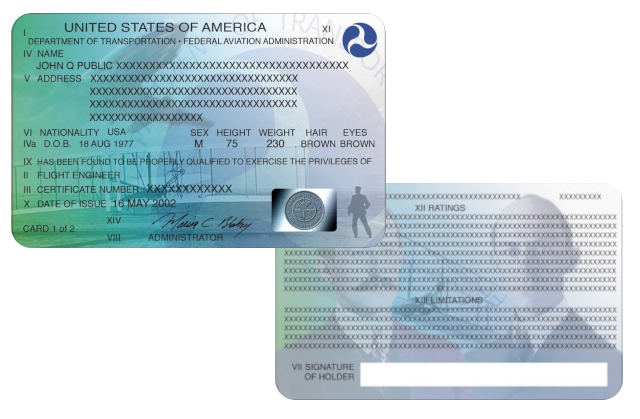
Adapted from Wikimedia Commons media in the Public Domain: Front and Back


1 Introduction
As per 14 CFR 61.3(a)(1)(i), every pilot operating an N-registered aircraft anywhere needs to hold an FAA-issued pilot’s license1. EU pilots with ambitions to fly in the United States are therefore required to hold an FAA license. Fortunately, EU pilots do not need to re-take theoretical or practical exams to obtain an FAA license.
2 Air Law Basics
3 Different Processes
As of 2024, there are two ways to obtain an FAA Private Pilot Certificate if a Private Pilot’s License of an EASA member state is already held.
Correct use of air law terminology is important. You are not “converting your European license”. You are also not “tranfering your European license”. You are simply “applying for an FAA Private Pilot Certificate”. This can be done under Title 14, § 61.75 (“based on a forein license”), or under Title 14, § 61.71 (“based on the Bilateral Aviation Safety Agreement Between the FAA and EASA”).
3.1 Title 14, § 61.75
This process is defined in:
Private pilot certificate issued on the basis of a foreign pilot license.
—Title 14, Chapter I, Subchapter D, Part 61, Subpart B, § 61.75
3.1.1 Requirements
- A foreign pilot license, at the private pilot license level or higher.
- A medical certificate issued by the same country.
- Ability to read, speak, write, and understand the English language.
3.1.2 Limitation
The issued license is only valid in combination with the EASA license on which it is based. In addition:
A U.S. pilot certificate issued under this section can only be exercised when the pilot has the foreign pilot license, upon which the issuance of the U.S. pilot certificate was based, in the holder’s possession or readily accessible in the aircraft.
—14 CFR 61.75(g)
3.1.3 Process
- Start a Foreign License Verification Process through IACRA.
- Start a New Application through IACRA (
Private Pilot > Foreign-Based).
Once the FAA has completed the foreign license verification:
- Try to make an appointment with an FAA Flight Standards District Office (FSDO).
Following a series of incidents where various parts of Boeing aircraft departed in-flight, things have not exactly been going well for the FAA. It is therefore entirely possible that the administrators at the FSDO of your choice will not give you an appointment, instead telling you:
This office is currently experiencing long lead times scheduling appointments due to Inspector resource issues. You may contact a FAA Designee (DPE w/Admin. function) to complete this type of request.
— Email communication by Farmingdale FSDO, March 2024
In this case, therefore:
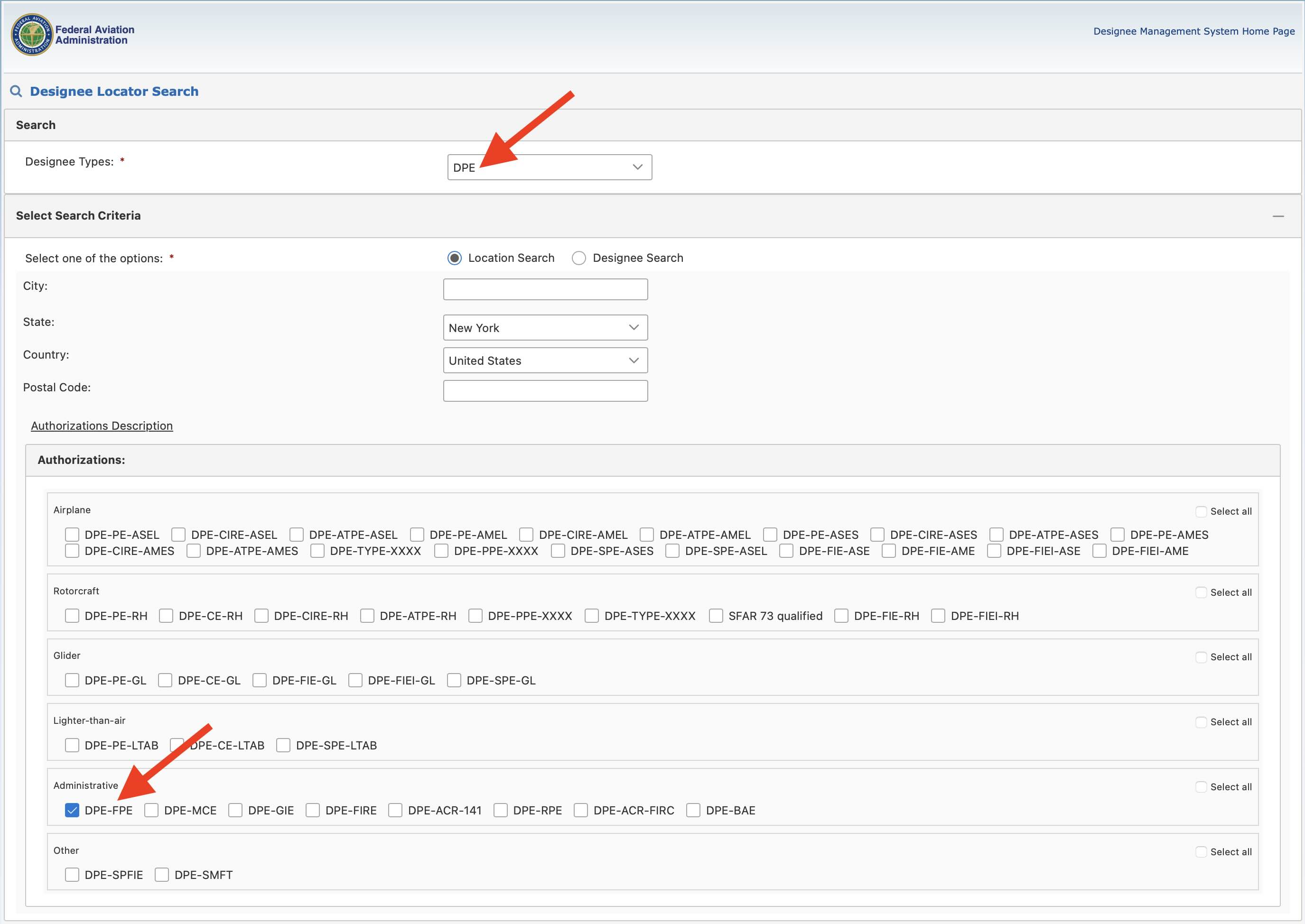
- Make an appointment with an FAA Designated Pilot Examiner/Foreign Pilot Examiner (FPE-DPE):
3.1.4 FAQ
3.1.4.1 Cost
Until recently, the entire process could be completed free of charge. Unfortunately, some FAA Flight Standards District Offices (FSDO) have started to outsource the final verification step to Designated Pilot Exminers (DPEs) which are also Foreign Pilot Examiners (FPEs). In 2024, the cost quoted by different DPE-FPEs in the state of New York ranged from 150$-750$.
3.1.4.2 Traveling to the US
No, some EU-based flight instructors offer an option where applicants can complete the entire process in the EU, see for example the offer of this flight instructor based in Southern Germany.
3.1.4.3 Flight Review Requirements
Until 2012, the FAA called this the Biennial Flight Review (BFR). With a 2012 FAA Advisory Circular (AC) AC 61-98B, the “biennial” was dropped “(…) because (…) [the FAA] want to encourage pilots to train with a CFI more often than once every 2 years, which is a good idea for any GA pilot.”
Yes, a recent Flight Review is required. It is irrelevant in which country you are operating the aircraft.
The FAA has clarified this in a 2013 legal interpretation:
A holder of a U.S. private pilot certificate that is based on a foreign pilot license as contemplated by § 61.75 would also have to meet the requirements of § 61.56(c). In other words, a person exercising the privileges of a U.S. private pilot certificate that is based on a foreign pilot certificate and satisfies § 61.75 is required to comply with § 61.56(c) before acting as pilot-in-command of a U.S.-registered aircraft.
— FAA Office of the Chief Counsel legal interpretation for Collins, 2013
Not every DPE-FPE is familiar with this requirement. Some incorrectly hold to the opinion that a flight review is only required for operating US-registered aircraft in the United States.
However, the FAA is unequivocal in their interpretation of § 61.56(c), as confirmed by the FAA Airman Certification Branch in response to my explicit request for clarification:
A person who is exercising the privileges of their U.S. pilot certificate must comply with the pertinent rules and requirements contained in part 61 (e.g., § 61.56 flight review requirements, recency-of-experience requirements, § 61.58 pilot-in-command (PIC) proficiency check, and § 61.51 required logbook entries) and in 14 CFR part 91. A flight review must have been administered by the holder of an FAA flight instructor certificate with the appropriate ratings. The proficiency checks administered by a foreign flight instructor do not meet the flight review requirements of § 61.56.
— E-Mail response by Tracey Little of the FAA Airmen Certification Branch
3.1.4.4 Type Rating Requirement
“Is it legal to operate a US-registered aircraft in Europe for which the US does not require a type rating, but the EU does?”
This seems to be a rather complicated issue involving not only FAA regulations, but also EASA regulations. While the FAA has two related legal interpretations, it would be prudent to get written confirmation from the relevant national Civil Aviation Authoriry (CAA).
Generally, the FAA states that such operations are legal under their regulations, since:
(…) [Drawing] the conclusion (…) that any and all limitations and restrictions that a pilot would be subject to under his foreign pilot certificate are incorporated in his US certificate, and apply equally under his US certificate [is mistaken] (…).
— FAA Office of the Chief Counsel legal interpretation for Krausz, 2012
However, it cautions that European CAAs might have additional restrictions in place:
(…) the FAA notes that our interpretation addresses only the requirements to operate a U.S.-registered aircraft under our regulations. Our conclusion in no way limits another country’s ability to impose other pilot certification requirements for flights operated within that country’s airspace.
— FAA Office of the Chief Counsel legal interpretation for Grossman, 2014
3.2 EU-US BASA
This process is defined in the Bilateral Aviation Safety Agreement Between the US and the EU. It has only been available since June 2021, when it was published as an Advisory Circular by the FAA.
3.2.1 Requirements
- A foreign pilot license, at the private pilot license level or higher.
- A medical certificate issued by the same country.
- Ability to read, speak, write, and understand the English language.
- The FAA “Private Pilot Airplane EU Part-FCL Conversion knowledge test with the code ‘PEP’”, with a minimum passing grade of 70 percent, no older than 24 months.
3.2.2 Limitations
None. A “standalone” FAA license is issued.
3.2.3 Process
You will need to look this up on your own…
3.2.4 FAQ
3.2.4.1 Returning the EASA License
No, as per section 10.1.7 of the relevant Advisory Circular, you can keep it.
 Except where otherwise noted, the content of this blog is licensed under CC BY 4.0
Footnotes
As was previously discussed on the Aviation StackExchange, it is possible for civilians to operate N-registered aircraft without a pilot’s license in compliance with federal aviation law. However, this is limited to aircraft being operated on behalf of federal or state governments.↩︎