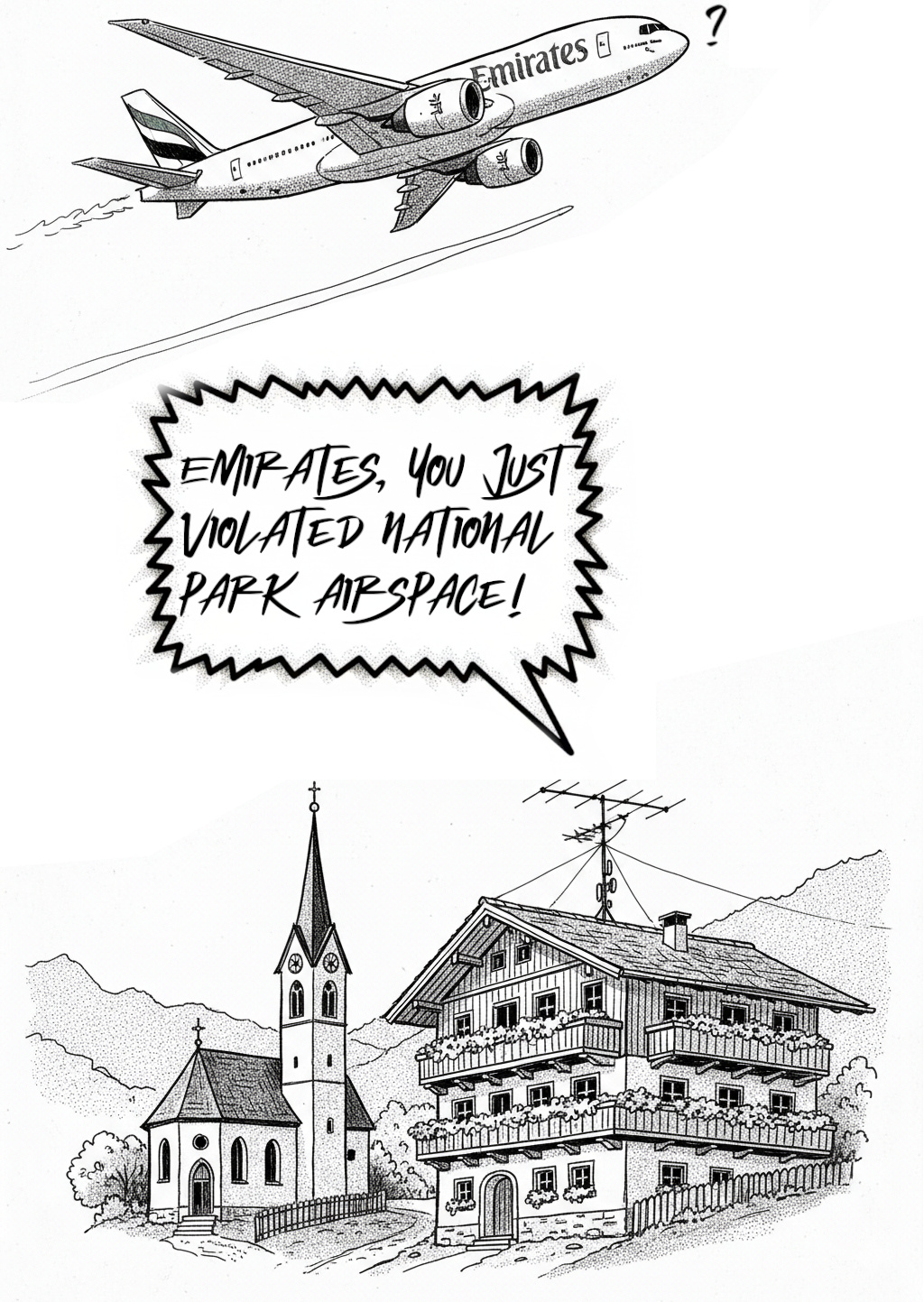
1 An “Illegal Flight”?
In early 2024, the local Tyrolean newspaper Tiroler Tageszeitung published an article describing how a helicopter flight in the Kaisergebirge mountain range resulted in legal action against the operator for apparently violating restricted airspace.
As the story goes, a group of professional tennis players were flown to a mountain hut, where a makeshift tennis court had been prepared for a charitable event. However, after the event, someone took issue with the flight and reported it to the authorities. The newspaper described this as:
Authorization for the landings had been obtained, since (…) [the landing site] was located just outside the Wilder Kaiser nature reserve. (…) However, the pilot flew the celebrity-laden helicopter (…) through the Ellmauer Tor. And with that, right through the middle of the nature reserve. (…) The Kufstein District Administration concluded in its investigation that the flights “violated the Tyrolean Nature Conservation Act and aviation regulations” (…).
Having flown around the Kaisergebirge on many occasions, this was both surprising and concerning to me - had I violated airspace in the past? After all, a quick glance at the official Austrian AIP VFR airspace map shows no restrictions:
The blue marker indicates the Ellmauer Tor mountain pass, as reported in the news story.
What is more, the Austrian AIP in section ENR 5.1 PROHIBITED, RESTRICTED AND DANGER AREAS lists only two restricted areas related to nature conservancy in the broad sense: LO R 16 NEUSIEDLER-SEE and LO R 18 RHEINDELTA. Both are far from the Kaisergebirge mountains.
Note
A court document released in September of 2024 finally provided insight into the legal case surrounding the helicopter flight:
The helicoper pilot had been accused not of an airspace violation, but of “significant noise development in the nature reserve” and of “conducting a sightseeing flight”, even though the permission he had obtained for an off-airport landing at the mountain hut was valid for direct flights to-and-from airports only.
Notably, the state administrative court ultimately dropped both charges. The first charge was dropped because no conclusive evidence for noise development could be established. The second charge was dropped on appeal because the accusation was too vague, failing to specify which of the five flights that day constituted the offense. This procedural error violated the pilot’s right to a proper defense, so the court dismissed the case without ruling on the actual legality of the flights themselves. As a telling example of this sloppiness, the court had failed to recognize that the pilot’s flight logs used UTC rather than local time, causing them to state the time of the offense incorrectly…
But in the context of this altogether confusing case, I wondered - is the Austrian AIP even complete with respect to airspace restrictions?
2 National Park Airspace in Austria
It is important to note that there are some important airspace restrictions above Austrian national parks, of which there are currently six. But learning more about them can prove quite exhausting!
2.1 State Law
Take, for example, Austria’s largest national park Hohe Tauern:
In the entire area of the national park, the following are prohibited: (…)
the use of motor-powered aircraft for sporting, tourist, or other commercial purposes below an altitude of 5,000 meters;
— § 6 lit. f) “Nationalparkgesetz Hohe Tauern, Tiroler” (translated)
Any motor-powered flights below 5’000m (~16’404ft) are therefore prohibited.
Violation of this law could result in a large fine:
Anyone who violates a prohibition according to (…) § 6 (…),
commits an administrative offense and is to be punished by the District Administration of Lienz (“Bezirkshauptmannschaft”) with a fine of up to 30,000 euros.
— § 32 (1) lit. a) “Nationalparkgesetz Hohe Tauern, Tiroler” (translated)
2.2 Restrictions in the AIP
As already mentioned, the Austrian AIP in section ENR 5.1 PROHIBITED, RESTRICTED AND DANGER AREAS does not list this restriction… and the same goes for many of the other national parks!
Important
While Austrian state law therefore definitely restricts the airspace above national parks, many of these restrictions have not been published in the national AIP as of 2025.
Besides Hohe Tauern national park, another interesting example is the Thayatal national park, which extends beyond the Danube into Czechia. Here, the Austro Control map clearly shows how a restricted area LKR4 which corresponds to the Czech side of the national park. However, again, no restricted area is shown on the Austrian side:
The Austrian part of the national park is shown in blue. Zoom in for better visibility.
2.3 Legal Basis for the AIP
This is all quite extraordinary, since Austria is a signatory to the Chicago Convention (“The Convention on International Civil Aviation”) - and is therefore obligated to publish information on restricted airspace in the Aeronautical Information Publication (AIP).
The convention, which in Austria has been adopted as a federal law, states that:
Any (…) Annex (…) shall become effective within three months after its submission to the contracting States (…)
— Art. 90 lit. a) “Abkommen über die internationale Zivilluftfahrt”
Annex 15 to the Chicago Convention further states that:
Note 1. - Detailed specifications concerning the content of each sub-domain are contained in the Procedures for Air Navigation Services - Aeronautical Information Management (PANS-AIM, Doc 10066), Appendix 1.
— Chapter 4.1, Annex 15 - Aeronautical Information Services to the Chicago Convention
Finally, the referenced document ICAO Doc 10066 defines:
Description, supplemented by graphic portrayal where appropriate, of prohibited, restricted and danger areas together with information regarding their establishment and activation, including: 1) identification, name and geographical coordinates of the lateral limits in degrees, minutes and seconds if inside and in degrees and minutes if outside control area/control zone boundaries;
2) upper and lower limits; and
3) remarks, including time of activity.
— Chapter ENR 5.1, ICAO Doc 10066
In Austria, the state-held Austro Control GmbH corporation is responsible for maintaining the AIP, as defined in federal law:
Austro Control GmbH shall assume all tasks hitherto assigned to the Federal Office for Civil Aviation in the Aviation Act (LFG) (…) Furthermore, Austro Control GmbH shall perform those tasks which have been assigned to it by federal laws or by ordinances issued on the basis of these federal laws. For these tasks, there is an obligation to operate. Austro Control GmbH must take all organizational measures to be able to fulfill these tasks under the supervision of the state authorities.
— § 2. (1), “Bundesgesetz über die Austro Control Gesellschaft mit beschränkter Haftung”
Note
Even if Austria were not a signatory to the Chicago Convention, Austro Control would still be obliged to provide a map including restricted airspace, because this duty is defined directly in Austrian law:
Austro Control GmbH shall create and publish at least the following aeronautical charts: (…)
Overview maps (in particular for the airspace structure and airspace restrictions) (…)
— § 96d (1), “Luftfahrtgesetz”
2.4 Aeronautical Maps
Commercial providers of aeronautical maps have taken different approaches to showing the airspace above national parks in Austria: SkyDemon is showing the airspace as “Bird Sanctuary” or “Nature Reserve” with altitudes derived from the state laws. Rogers Data has taken a similar approach. Notably, the company publishes an excellent guide on airspace restrictions on their website. Austrian ATC provider Austro Control in their map does not show any restrictions. In addition, their current color scheme makes it hard to make out the national parks on the map.
Toggle different aeronautocal map layers on/off to compare them.
2.5 Forum Discussions
The confusion around the topic of airspace restrictions has sparked debate in pilot communities online. One notable examples is at the SkyDemon forum:
As an international pilot flying into Austria, all airspace that is prohibited or restricted in any way must be in the AIP. It sounds like perhaps information about these areas is deliberately vague, and meant to scare Austrian pilots into avoiding areas that are technically not promulgated aeronautically?
— Tim Dawson of SkyDemon in a forum discussion
and one in the Pilot und Flugzeug forum:
The topic of “National Parks in Austria” is, however, a somewhat sad chapter of inconsistent regulations when, in the aforementioned national park alone, each of the three adjacent federal states offers different rules for aviators, and these are only published in the respective state laws.
— user “Flieger Max Loitfelder” in a forum discussion (translated)
3 Conclusion
The current situation is a perplexing and legally ambiguous mess. Airspace restrictions over national parks are defined in various German-language state laws, but critically not in the official Aeronautical Information Publication (AIP) available to pilots. Some commercial map providers have attempted to depict these areas in their maps, but with no corresponding documentation of these areas in the AIP, pilots are left wondering as to their official status.
This is a most dissatisfying situation from a flight planning perspective, especially for international pilots who cannot reasonably be expected to research obscure regional legislation. Especially, since pilots should be aware that according to the Standardised European Rules of the Air (SERA):
Before beginning a flight, the pilot-in-command of an aircraft shall become familiar with all available information appropriate to the intended operation. (…)
— SERA.2010 Responsibilities (emphasis mine)
But does “all available information” include German-language-only state laws, all hosted at different state websites, each using different terminology to describe airspace restrictions? A textbook example of the legal maxim 𝔦𝔤𝔫𝔬𝔯𝔞𝔫𝔱𝔦𝔞 𝔧𝔲𝔯𝔦𝔰 𝔫𝔬𝔫 𝔢𝔵𝔠𝔲𝔰𝔞𝔱 (“ignorance of the law is not a valid excuse”).
Informal discussions with members of the Austrian Aircraft Owners and Pilots Association (AOPA) has indicated that despite occasional rumors, the association is not aware of any pilot having ever been fined for violating national park restricted airspace. It seems that the Austrian air traffic provider Austro Control, which would need to be involved in any legal action one way or another, would have little interest of pursuing such action. After all, they are responsible for promulgating airspace restrictions defined in state law into the AIP. A textbook example of the legal maxim 𝔲𝔟𝔦 𝔫𝔬𝔫 𝔞𝔠𝔠𝔲𝔰𝔞𝔱𝔬𝔯, 𝔦𝔟𝔦 𝔫𝔬𝔫 𝔦𝔲𝔡𝔢𝔵 (“where there is no accuser, there is no judge”).
Ultimately, the current state of affairs is not only confusing but also represents a failure to comply with ICAO standards under the Chicago Convention. For the sake of flight safety, legal clarity, and regulatory transparency, it is imperative that these state-level restrictions are officially incorporated into the national AIP.
4 Resources
5 Acknowledgements
The author would like to thank members of AustroControl GmbH, Rogers Data GmbH and SkyDemon for granting permission to display excerpts of their respective aeronautical charts. The author would also like to thank Mr. Markus Weinold for providing invaluable assistance during legal research and Mag. Lorenz Rieser for pointing to the official court ruling on the helicopter flight which inspired this article.
 Except where otherwise noted, the content of this blog is licensed under CC BY 4.0